

Analysis
US Maritime Plan Sails into the Wrong Century: Why Clean Energy is Key to Future Sea Power!
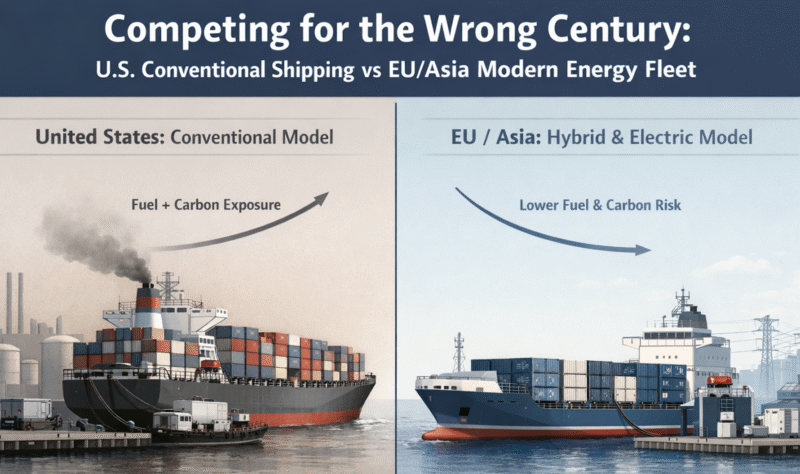
TL;DR: The new U.S. Maritime Action Plan means well, but it's like bringing a flip phone to a smartphone convention. Critics say it's stuck in the 20th century, focusing on protectionism and traditional shipbuilding while largely ignoring clean energy architecture, electrification, and modern carbon constraints. Plus, it completely dodges the elephant in the shipping lane: the Jones Act. This strategy could leave the U.S. with an expensive, outdated fleet in a rapidly decarbonizing global market.
Meta: US Maritime Plan criticized for 20th-century approach, ignoring clean energy and the Jones Act, risking an outdated fleet.
Alright, alright, alright! Now, Uncle Sam's got a new plan for maritime power, and they're calling it the U.S. Maritime Action Plan. Sounds official, right? But some folks are looking at it like, 'Hold up, is this plan for this century, or the last one?' See, while it acknowledges some real issues like withered shipbuilding and workforce shortages, the diagnosis might be solid, but the prescription? It feels a little…retro. It's like trying to win a drag race with a horse and buggy when everyone else is driving Teslas.
Sailing Against the Carbon Tide
The global shipping industry is already feeling the heat, and I ain't talking about climate change – I'm talking about carbon pricing! Europe's got its Emissions Trading System, FuelEU Maritime is tightening greenhouse gas intensity, and the IMO's aiming for net-zero by 2050. These aren't just suggestions; they're legally binding rules that are slapping big costs on fossil-fueled vessels. So, if your ship is burning dirty fuel, it's gonna cost you, literally.
But this U.S. plan? It barely mentions energy architecture as a core competitiveness lever. No electrification targets, no integrated strategy for port electrification, no clear industrial base for maritime power electronics. Energy appears as background noise, not the main melody. Meanwhile, battery electric and hybrid propulsion aren't just feel-good initiatives; they're massive cost structure shifts. Imagine cutting fuel burn by 30% and dodging millions in carbon penalties! The economics aren't subtle, they're screaming for change.
The Elephant in the Room: The Jones Act
Now, here's where it gets really spicy. The plan talks about strengthening cargo preference and imposing fees on foreign vessels. It's all about protection, baby, mid-20th century style. But it completely ignores the gigantic, unmentionable whale in the room: the Jones Act. That's the law that demands U.S. built, U.S. owned, U.S. crewed vessels for domestic trade. Not a single mention in the whole plan! That's not oversight; that's avoidance, plain and simple. It's like writing a script about a broken family and never mentioning the dad.
If the Jones Act is strengthening security, defend it! If it's distorting costs and slowing modernization (which many argue it is), then confront it and reform it! Silence isn't strategy, it's cowardice. The world market ain't waiting for American political comfort. A ship ordered in 2026 will be operating into the 2050s, facing these carbon rules. If the U.S. builds fossil-heavy tonnage, it's just creating a protected niche that'll be structurally expensive to operate, putting the cost on American consumers through higher freight rates.
What's Next
To truly compete, the U.S. needs industrial policy with energy realism. Maritime security needs energy architecture at its core. This means integrating battery systems, high-power conversion, thermal management, and shore infrastructure as baseline design elements. It means tying federal procurement to energy performance and setting measurable goals for hybrid fleets. If not, the U.S. risks building a fleet that's already obsolete before it even hits the water. We need to adapt, baby, or get left behind!
And that's the bottom line, 'cause Eddie said so! I'm out!
Previous
Waymo's 6th-Gen Driver: Smarter, Cheaper, and Ready to Roll in Any Weather!
Next
Apple CarPlay Hits a Speed Bump at Tesla: Maps Misfire Delays Rollout!

Eddie W
Author
Need an OG image?
Share this story to automatically generate an image via /api/og.
Comments
Join the discussion below.