

Analysis
Canada's EV Policy Shift: Credits, Not Commands, Fueling the Electric Revolution
TL;DR: Canada's getting sneaky smart with its EV policy, folks! Instead of barking orders with sales mandates, they're using a slick credit system and tightening emissions standards. It's all about the math now, forcing automakers to electrify or pay up, and even opening the door for affordable Chinese EVs. This ain't your grandma's EV policy, it's a quiet revolution!
Meta: Canada is quietly shifting its EV policy from explicit sales mandates to tightening fleet average emissions standards, using a credit trading system to drive electrification.
Alright, alright, settle down now! You know, sometimes the loudest policies ain't the most effective ones. And Canada, bless its polite heart, seems to have figured that out. They've quietly switched up their EV game, moving away from those in-your-face EV sales quotas and towards something a little more... subtle. We're talking about steadily tightening fleet average emissions standards, paired with an open credit trading system, and a strategic wink to lower-cost electric vehicles from overseas. It's like they're saying, "We ain't gonna tell you what to do, but we're gonna make the numbers work out for us!"
The Math Behind the Mandate
The big change here is the tightening of fleet average greenhouse gas emissions standards. Forget needing a fixed percentage of EVs; now, every vehicle a manufacturer sells, whether it's a gas-guzzling Silverado or a slick Blazer EV, counts towards a single average. EVs? They count as zero emissions, baby! Gas cars? They get hit with their CO2 numbers. And this standard gets tighter every single year. A 10% annual reduction is the vibe, meaning by 2032, you're looking at a serious squeeze on emissions. It's like trying to fit into your old jeans after the holidays – the pressure just keeps building!
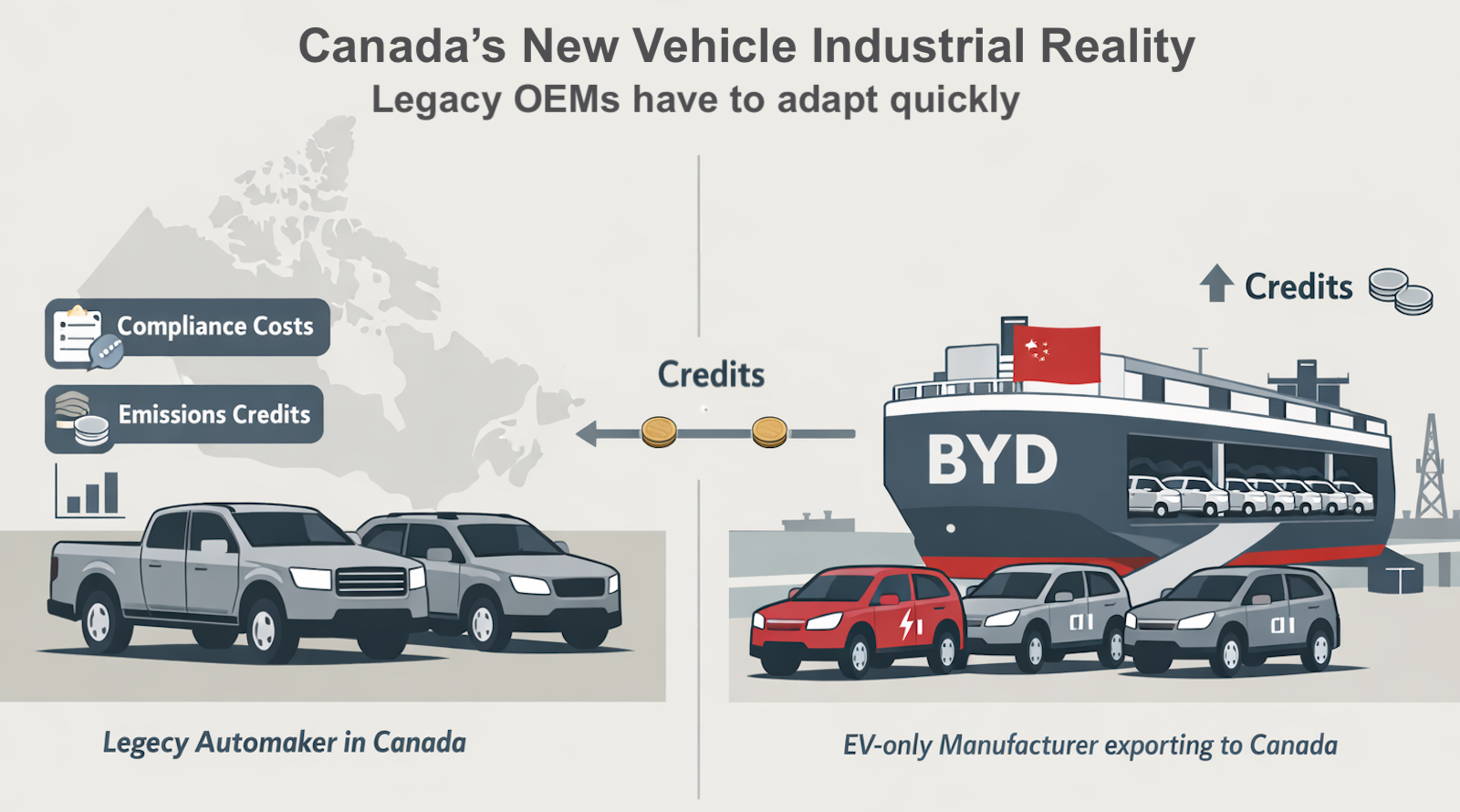
And these ain't just abstract numbers. We're talking about lifetime emissions, folks. A zero-emission vehicle can generate tons of lifetime CO2 credits. If credit prices are, say, $100 per ton, that's thousands of dollars in credit value per EV! These credits can be traded between companies. So, if GM is selling a whole lot of big trucks, and not enough EVs, they gotta buy credits from someone else. And who's got a whole lot of credits? Companies like BYD, that are selling nothing but EVs. It's a system designed to make money flow from the dirty fleets to the clean fleets. Now, that's smart economics!
The Chinese EV Connection: A Strategic Advantage
And here's where it gets really interesting: Canada is letting up to 49,000 Chinese-built EVs into the market annually with a standard 6.1% import duty, instead of some sky-high surtax. Why? Because these all-electric fleets massively over-comply with emissions standards and generate a ton of tradable credits. For a company like BYD, a $30,000 EV might cost them about $1,830 in tariffs, but generate $5,000 to $7,400 in credit value! That's a net benefit of thousands per vehicle. Scaled up, that's hundreds of millions in potential credit value. It's like finding a secret cash register that only takes green vehicles!
This ain't a subsidy to China; it's a market mechanism. Legacy automakers are paying for emissions reductions they haven't delivered themselves. It forces them to either ramp up their own EV production or keep paying other companies for their clean vehicles. The longer they wait, the more expensive it gets. The arithmetic doesn't lie, folks. It's a relentless system that doesn't care about your product cycle; it only cares about those numbers!
What's Next
Canada's new EV policy framework is a sophisticated approach that leverages market forces to accelerate electrification. It will likely increase competition, drive down EV prices, and significantly diversify the electric vehicle offerings in the Canadian market. Legacy automakers will face increasing pressure to electrify their fleets, and the trade policy favoring low-cost EV imports could pave the way for a more competitive North American EV landscape. This approach could serve as a blueprint for other nations seeking to incentivize EV adoption without resorting to outright bans.
So, Canada's not just talking the talk; they're doing the math, and the math says 'electric'! You know, sometimes the quiet ones are the smartest. And that's no joke, that's just Canadian efficiency!
Previous
Starlink Blasts Off to Super Bowl Commercials: From Space to Your Living Room!
Next
Rivian R2: Smaller, Sharper, and Ready to Roll into the Mainstream!

Eddie W
Author
Need an OG image?
Share this story to automatically generate an image via /api/og.
Comments
Join the discussion below.