

Analysis
The Book That Blocked Progress: How an Energy Classic Became a Decarbonization Drag
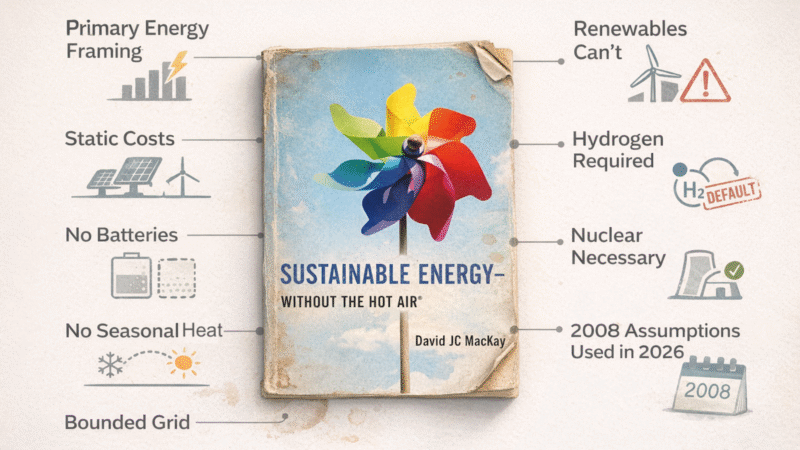
TL;DR: David MacKay’s 2008 book, "Sustainable Energy Without the Hot Air," once a groundbreaking analysis, is now seen by some as an impediment to decarbonization efforts, with its outdated assumptions about renewables, storage, and hydrogen holding back modern energy strategy. It’s like using a flip phone to navigate the metaverse, baby – it just ain't gonna work!
Meta: David MacKay's influential 2008 energy book is now criticized for hindering decarbonization due to outdated assumptions.
Now, listen. Back in 2008, when David MacKay dropped his book, "Sustainable Energy Without the Hot Air," it was a big deal. The man was a genius, a physicist, and he came at energy debates with numbers, with scale, with cold, hard facts. He made folks actually think about how much energy we use and what it would take to replace fossil fuels. And for that, we salute him. He cut through a lot of green-washed fluff, forcing a reality check. But here's the kicker: what was state-of-the-art back then? Well, let's just say a lot has changed since Britney Spears shaved her head.
The problem isn't that MacKay was wrong for his time; it's that his work is still being cited like it's fresh off the presses in 2026. The world has moved on, and clinging to old frameworks, no matter how influential, can drag us down. His central framing, anchored in "primary energy," unintentionally exaggerated the scale of the decarbonization challenge. See, primary energy counts the heat content of fossil fuels, much of which gets wasted. Electrification, on the other hand, is way more efficient. By sticking to that fossil-era baseline, the book made the problem seem bigger than it needs to be with modern tech. It's like measuring how much food you buy versus how much you actually eat – two very different numbers.
Missing the Revolution
MacKay's book also didn't, couldn't, anticipate the absolute revolution in renewables and storage. Back in 2008, solar was pricey, wind was still finding its feet, and grid-scale batteries were basically science fiction. He saw them as contributors, but not dominators, concluding they'd need massive land use and couldn't compete without heavy support. Fast forward to today: solar costs have dropped by 70-90%, offshore wind is a beast, and batteries? Oh, those lithium-ion marvels have plummeted in cost by about 85%, largely thanks to EVs. They're now displacing gas peakers and making the old "baseload" argument look, well, baseless.
Another blind spot was the power of interconnectors and thermal storage. MacKay mostly focused on the UK's national level. But cross-border grids smooth out variability like a pro DJ. And seasonal thermal storage, like aquifer systems? They were already a thing in Northern Europe, but weren't given their due as a core system lever. By underestimating these, the book made the problem of winter heating and grid stability seem harder than it actually is, nudging the analysis towards hydrogen or synthetic fuels as the only answers.
The Hydrogen Hangover
And speaking of hydrogen, MacKay was clear about its inefficiencies, with round-trip losses exceeding 60% when converting electricity to hydrogen and back. Yet, the book's framing allowed hydrogen to remain a plausible energy carrier rather than just an industrial feedstock. This distinction is crucial now. Using hydrogen for industrial processes where it's chemically unavoidable? Sure. Using it to move energy around an already electrified system? That's just inefficient, like sending a telegram when you've got Wi-Fi.
This outdated framing, still influencing policy tools like the UK carbon calculator, makes it hard to imagine a future without hydrogen as an energy carrier, even when direct electrification and other storage options are clearly superior. It's turning modeling assumptions into policy constraints, justifying investments in infrastructure that may struggle to find an economic role. It’s not about MacKay’s intent, but about how his early choices, however reasonable at the time, shape decisions years later.
What's Next
For meaningful decarbonization, we need to retire the outdated assumptions about primary energy, the limited scope of renewables, and the structural necessity of nuclear and widespread hydrogen as an energy carrier. Future energy strategies must fully embrace the dramatic cost reductions and scaling capabilities of wind, solar, and battery storage, alongside smart grid management and thermal energy solutions. Continuing to treat MacKay's 2008 analysis as current is simply a recipe for expensive, inefficient, and slow decarbonization.
So, while we respect the pioneers, it's time to move on, baby! The future ain't waiting for yesterday's playbook. You got it? Good!
Previous
Ditching the Peaks: New "No-Mountain" Pumped Hydro System Promises Energy Storage Anywhere
Next
Nissan Leaf Takes on the Highway: Surprising Cold-Weather Range Test Results for the 2026 Model!

Eddie W
Author
Need an OG image?
Share this story to automatically generate an image via /api/og.
Comments
Join the discussion below.